
Cash flowAugust 26, 20268 min read
Profit vs. Cash Flow: What Business Owners Need to Watch
If the income statement says the business made money, why can the bank balance still fall? The timing lives between the two.
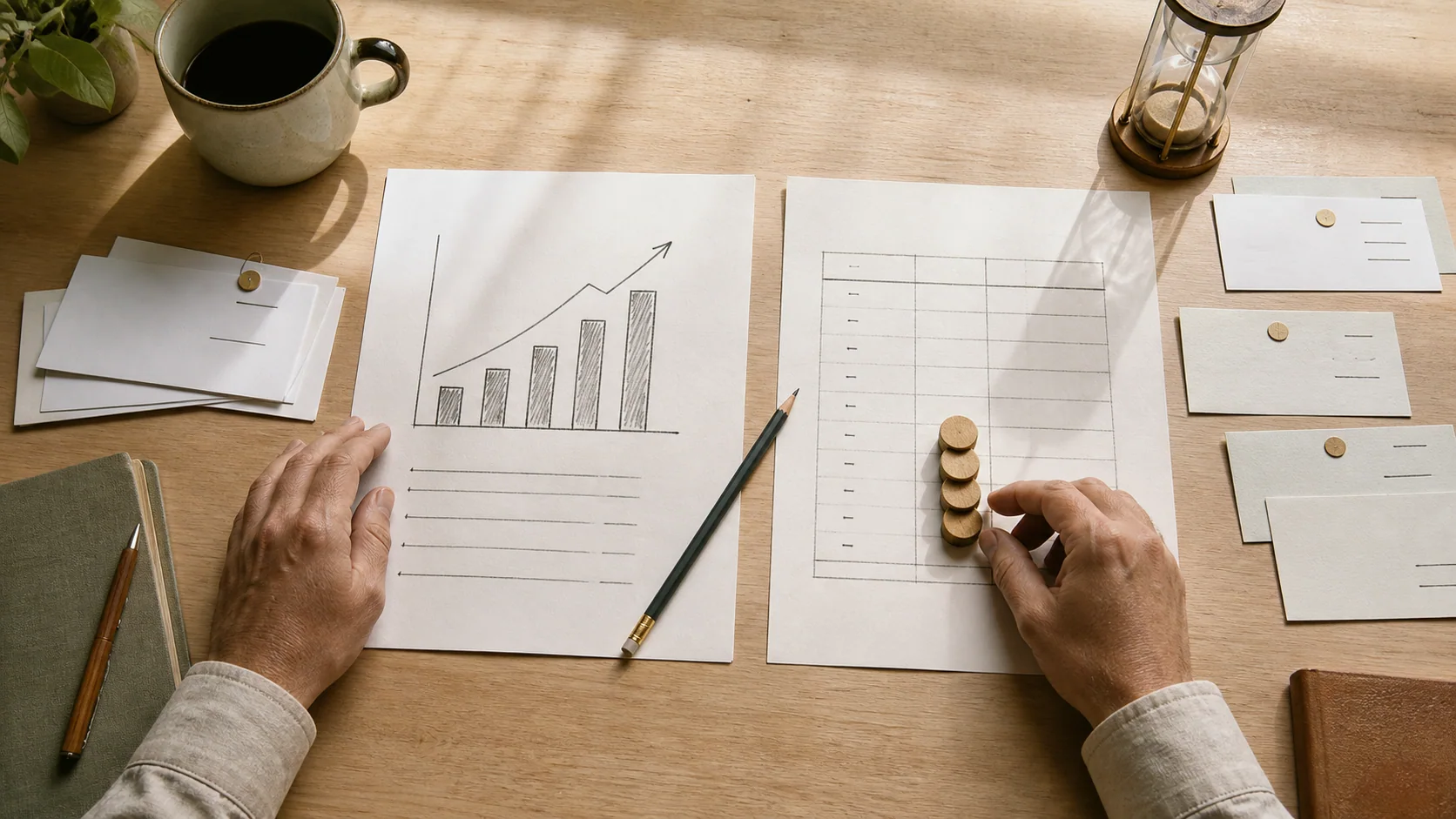
One of the most unsettling small-business questions is also one of the most common: If we made money, why is there less cash in the bank?
The answer is usually not that profit is fake or accounting is broken. Profit and cash answer different questions. The income statement measures revenue earned and expenses incurred over a period. Cash flow follows actual money moving through operating, investing, and financing activity.
The distance between those views is where growing businesses can get surprised.
Illustrative cash bridge
How $25,000 of profit becomes a $33,000 cash decrease
Profit can arrive before the cash
Under accrual accounting, revenue is generally recognized when it is earned, not necessarily when the customer pays. A business can complete $40,000 of work, issue the invoice, and report the revenue while the cash remains in accounts receivable.
That timing difference is ordinary, but it matters. Payroll, rent, and vendors may be due before the customer’s payment arrives. The income statement can show a good month while the bank account absorbs the wait.
Cash-basis businesses experience the timing differently because income is generally recognized when received and expenses when paid. Even then, equipment purchases, debt activity, owner transactions, and future obligations mean the bank balance still does not tell the whole operating story.
Some uses of cash do not reduce current profit the same way
Suppose the business buys equipment for $15,000. Depending on the accounting and tax treatment, that purchase may be recorded as an asset and affect profit over time through depreciation rather than appearing as a $15,000 operating expense immediately. Cash still leaves now.
Loan principal works similarly. Paying principal reduces the loan balance and cash, but principal is not an interest expense. Owner draws or distributions generally reduce cash without becoming an operating expense, although entity and tax treatment varies.
The reverse can also happen. Taking on debt adds cash without creating revenue. Delaying a vendor payment preserves cash temporarily while leaving the expense and obligation in place.
A profitable month with falling cash
Consider a simplified, illustrative month. The business earns $100,000 of revenue and incurs $75,000 of expenses, producing $25,000 of profit. Customers, however, owe $40,000 more at month-end than they did at the beginning. The business also buys $15,000 of equipment and repays $8,000 of loan principal. Vendor balances rise by $5,000, which preserves that amount of cash for the moment.
Start with $25,000 of profit. Subtract the $40,000 increase in receivables, add the $5,000 increase in payables, subtract the $15,000 equipment purchase, and subtract the $8,000 principal payment. Cash falls by $33,000 even though the month was profitable.
That is not a contradiction. It is a timing and funding story that becomes visible only when the income statement, balance sheet, and cash-flow view are read together.
What an owner should watch
Begin with a small set of connected signals. Track the cash balance, but also track what is scheduled to leave and what is reasonably expected to arrive. Watch receivables by age, not just in total. Review gross margin, because weak margin eventually becomes a cash problem even when collections are fast.
Include inventory commitments, tax payments, payroll, card payments, debt service, equipment, and owner distributions in a short cash forecast. Eight to thirteen weeks is often detailed enough for near-term decisions, while a longer monthly view can support hiring and investment planning.
- How many weeks of payroll and fixed obligations can current cash support?
- Which customer payments are assumed in the forecast, and how confident are we in their timing?
- Is cash tied up in slow collections, inventory, or work that has not been billed?
- Which planned purchases or distributions can move if collections arrive later than expected?
Do not manage from either number alone
Cash is not the only measure of health. A business can temporarily hold plenty of cash because it borrowed money, delayed vendors, collected deposits for work not yet performed, or has taxes coming due. Profit is not sufficient either. A profitable company can run out of cash when growth, collections, inventory, or debt timing outruns its working capital.
The stronger habit is a three-part conversation: Is the work profitable? Where is the cash tied up or committed? What does the next cash low point look like under realistic timing?
When those answers are reviewed together, the bank balance stops being the entire decision system. It becomes one important piece of a fuller view.
This week
Make one useful move.
Choose the next eight Fridays. List expected customer receipts and the unavoidable cash outflows under each date. The first low point you see is more useful than a vague promise to 'watch cash.'Sources and further reading
These sources informed the factual framework. The examples and commentary are Honeybee's plain-language interpretation.
- Beginners’ Guide to Financial StatementsU.S. Securities and Exchange Commission
- Publication 538: Accounting Periods and MethodsInternal Revenue Service
- Money Smart for Small BusinessFDIC and U.S. Small Business Administration
- Cash flow management basics for small businessesBank of America
This article provides general educational information. It is not tax, legal, investment, audit, or attest advice and does not create a client relationship or authorize work.